


An institute employee held a lesson with teachers from the Nizhny Novgorod region
 |
08 11.2025
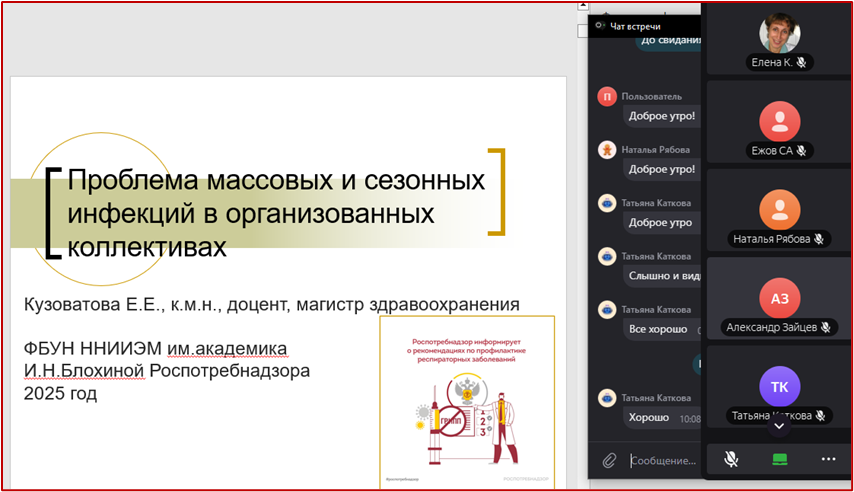
On November 8, 2025, the head of the infectious disease specialist at the Volga District Center for the Prevention and Control of AIDS, PhD, Associate Professor E.E. Kuzovatova, held an online lesson on the prevention of influenza and acute respiratory viral infections.
|
Thirty-one teachers from comprehensive schools in the Nizhny Novgorod Region participated in the videoconference. During the event, E.E. Kuzovatova discussed the current respiratory season, particularly influenza. The teachers were briefed on the basic principles of preparing educational institutions for work during an epidemic. Particular attention was paid to the need to monitor staff and students' compliance with sanitary and hygienic rules and personal hygiene. E.E. Kuzovatova explained and demonstrated how to properly put on, wear, remove, and dispose of medical masks.
The 2025/2026 influenza season is characterized by the predominance of the A(H3N2) strain. This and other circulating strains are included in vaccines, making vaccination a relevant and particularly effective method of preventing severe forms of the disease.
|
 |